
STUFF WE THINK WE KNOW
(AN EXTREMELY CATHOLIC, WEIRDLY MEDIEVAL WEDNESAY RESEARCH RABBIT HOLE)

hello, how are you all? i’m – you know what, never mind. instead of that, let’s open these reflections with some sexy chat about papal infallibility, ghosts, and the limbo of infants. ready? no? great.
funny where the mind goes, isn’t it? i woke up the other morning thinking about papal infallibility. specifically, what it means and what it’s for. we get it wrong, you know? when we frame it in our minds, especially when we think about the position of the church during the long middle ages. i mean, the concept doesn’t enter into ancient texts at all; it’s a solid non-issue right up until the council of antioch (264). the idea of the church as indefectible is present, although the meaning of indefectible is closer to enduring and immutable than to perfect and unerring. read indefectible not as some kind of grotty totalising omniscience, but as dogged persistence in the face sin, human weakness, suffering and persecution. while indefectible describes a quality of the church on an institutional level, it might be said equally to describe the radical commitment (and the monumental task) of its individual living members. personally, i like dorothy day on this: ‘nothing but a divine institution could have survived the betrayal of judas, the denial of peter, the sins of many of those who professed her faith, who were supposed to minister to her poor’. yes, double d, you tell ‘em. basically, there is a special grace or truth to christ’s teachings that allows the community of christ to survive the assorted degradations, failures, and fuck ups of its moving human parts.
okay, onwards. during the high middle ages (11th-13th centuries) it is safe to say that popes wielded a phenomenal amount of power, both spiritual and temporal (through the papal states, duh). still no mention of papal infallibility, although “hildebrand” gregory vii (1073-1085) did claim a highly exalted position for the papacy, and innocent iii (1198-1216) – nullifier of the magna carta, orchestrator of the fourth crusade/ the sack of constantinople, and signer-off on the founding of the francisan brotherhood, busy boy – went even further, claiming to exercise ultimate authority in the temporal sphere as well (!) yeah. and, i mean, the papacy was at the height of its powers then, so, dick that he was, he wasn’t wrong.
but it wasn’t until we get to pope nicholas iii (1277-1280) that the idea of papal infallibility truly arises, and it does so within the context of increasing franciscan influence at the papal curia. so, following the example of st francis (the best saint) the franciscans lived in poverty, but the papacy owned all of their former wealth and the church supported them in their renunciation of worldly goods. the argument put about by such franciscan luminaries as metaphysician peter olivi was that if a so called “pseudo-pope” ever rose to power, said “pseudo-pope” could deprive the franciscans of their rights. he wanted (needed) the statements of popes to be infallible in the special sense of being irreformable. that is, no pope could undo the utterances of his predecessors. this. is. huge. it tells us papal infallibility was an expedient to limit potentially damaging power, not to enforce or consolidate it.
william of ockham (1287-1347) brings up infallibility in this sense once again with respect to pope john xxii (1313-1334) that hot-tempered nemesis of meister eckhart. dear john came to power at a time of great tension between the diocesan clergy and the monastic orders. accusations of heresy were flying thick and fast, and pope john was on a mission to curb what he considered the rampant excesses of the spirituals. not least the interpretation (supported by nicholas iii) of the franciscans that christ and his apostles lived without property. this he dismissed in the bull quum inter nonnullos on the 12th november 1323 as ‘erroneous and heretical’. a whole lotta back and forth ensued, with ockham and his supporters arguing for papal infallibility in order to bind john to the declaration of his predecessor.
also around this time mad beef was brewing between the franciscans and the dominicans, both groups of mendicant friars jostling for the canonisation of saints belonging to their orders. partly to keep a lid on this bickering, the papacy began to take an active role in deciding which saints ought to be officially canonised. representatives from both sides needed to argue, then, that the pope was infallible in matters of canonisation.
i won’t even get into the western schism (!) my point is that infallibility is less a matter of obedient and unthinking “faith” than political expediency. it is subtle and slippery and multifaceted; very much emerging from the uniquely pressured political context of the high middle ages. convinced? i mean, despite the reformation, which saw anxious catholics looking to the pope as a symbol of continuity and faith in newly protestant countries, papal infallibility doesn’t even get a look in at the council of trent (1545-1563), and thems was desperate times kids (!)
you may or may not, in fact, be surprised to learn that it wasn’t until the nineteenth century that the first vatican council (1869-1870) decreed the pope infallible when he spoke ex cathedra on matters of faith and morals. this was in response to pope pius’ (1846-1878) decree that the doctrine of the immaculate conception is infallible (uh-hu). and, i shit you not, the only other time a pope has spoken infallibly ex cathedra was in 1950, and this bull defined the doctrine of mary’s assumption into heaven. give yourself a minute. ‘cause we can definitely have an opinion about why the only infallible ex cathedra pronouncements centred the mother of chirst, can’t we? why her virginity needed to be immaculate, perpetual and supernatural. but that’s another story for another time, and in any case, marina warner already told it in 1970 (alone of all her sex is a banger, and i will fight anyone who says otherwise).
and the point of all that was what, exactly, fran? well, on one level, i find medieval research rabbit-holes very comforting when the present is hard to comprehend and reconcile with. but also, i suppose i was thinking about the things we think we know; how the grip we actually have on the world (and on quite a wide range of important concepts) is actually pretty partial; pretty cobbled and approximate. which isn’t our fault: it’s impossible to know everything down to its gritty, grainy particulate, and some things (e.g. papal infallibility) are going to be a lot less immediately relevant to most people’s lives than others. we can’t question everything or we wouldn’t make it through our day. but as a habit, assuming we know – better, best, at all – is a dangerous and distorting way to approach the world. not to mention an ultimately impoverishing inoculation against curiosity and – well – joy and interest. what i mean is, when we assume we already know we deny ourselves the opportunity/ the capacity to become fascinated; to uncover the weird detail that adds richness and texture to life. and life is weird. whatever else it is, it is not boring. although individual moments in individual lives (work, for instance) definitely are boring – don’t be confused – life – nature, language, physics, history – never is.
another insanely catholic for instance for you: “fran”, i am often* asked “what’s with this limbo of infants malarkey? what kind of effed up doctrine is that?” so glad you asked, angry hypothetical protestant, but less of the attitude, thank you.
seriously, though, i love talking about this, so please brace for impact: first up, it’s not doctrine, officially it never was, so wind your neck in. second, we owe the concept of a natural (as opposed to supernatural or heavenly) happiness for unbaptised infants to the latin fathers, and a fifth century controversy stirred up by pelagius who reasoned – sensibly enough, we might reckon – that infants could be saved without baptism, and that dying unbaptised would enter into ‘eternal life’ (although not necessarily the ‘kingdom of god’ – more of which anon). pelagius taught that god would not condemn to hell those who were not personally guilty of sin. this was considered wildly troublesome because it questioned the established reading of st. paul’s letter to the romans, that all human beings sinned ‘in adam’, and that adam’s sin was transmitted to his descendants. and boy howdy, did pelagius’ alternative take generate some beef. specifically, with everyone’s fave fifth century misogynist, st augustine (boo-hiss). for augustine, pelagius’ teaching undermined belief in christ as the one mediator, and in the need for the saving grace he won for us on the cross. his logic ran – and in purely logical terms, it’s hard to dispute – that if infants are truly born without sin, why baptise them at all? no, according to augustine, unbaptised kids ended up in hell. and in 418, the council of carthage condemned pelagius’ opinion, at least to the extent that ‘even children who of themselves cannot have yet committed any sin are truly baptised for the remission of sins, so that by regeneration they may be cleansed from what they contracted through generation’ and that there is no ‘intermediate or other happy dwelling place for children who have left this life without baptism, without which they cannot enter the kingdom of heaven, that is, eternal life’.
well, okay. but the ruling very far from finished the matter, and the idea of a “third place”– free from suffering yet deprived of the beatific vision of heaven – for those who died without personal sins, continued to be persuasive and appealing to people. most medieval scholars chose to greatly soften augustine’s stern interpretation of st. paul to instead emphasise the goodness of god, whose only ‘punishment’ for those who sinned ‘in adam’ was to deny them the supernatural happiness of the kingdom of heaven. instead it was believed that being below the age of reason, these unbaptised children would feel no pain at all in the life hereafter, but that they would enjoy a full natural happiness through their union with god in all natural goods.
okay so, around 1300 this happy “third place” got a name: the limbo of infants. an interesting factoid here is that limbo literally means ‘outer edge’. the limbo of infants, then, was technically located at the furthermost rim of hell (!) although no physical tortures were meted out there. scholars did debate quite hotly whether separation from god was a form of suffering in and of itself, but broad consensus was of a pleasant place, made more so by the ever-present possibility of salvation through christ.
fairly interesting, right? but nowhere near as interesting as considering the entirely temporal/ practical reasons a limbo for infants became necessary in the first place. for instance: ghosts, and plenty of them. i mean, the long middle ages was a haunted time. mortality was high. infant mortality was really high. and the revenant spirits of suicides, victims of accidents, or babies who died unbaptised were greatly feared. limbo, and the limbo of infants in particular, was needed as a refuge for the wandering souls (including miscarried or aborted foetuses) who, through no fault of their own, could never reach paradise.
with me so far? no? great. ‘cause here comes the tangent. often confused with the idea of limbo, there is the official doctrine of purgatory (a temporary, painful state of purification for baptised souls, in which to atone for venial sins before entering heaven). this has been part of catholic life and belief since around the twelfth century. and purgatory really had its uses. not least, the (notorious) monetisation of indulgences, where the church suggested that monetary donations could reduce the time a soul spent in purgatorial fire. but also, purgatory was deployed to institutionalise pre-existing cultural superstitions surrounding the dead. ghosts (!) their appearances and purpose could be brought under the authority of the church. so that rather that “restless spirits” trapped on earth, ghosts (and ghost stories) could be utilised as souls in purgatory, temporarily allowed to appear to the living in order to request prayers, penances, or to provide warnings/ instructive moral lessons. these apparitions served, in short, as a kind of spooky ‘propaganda’.
like a specific example? coolsies: may i introduce you to hellequin’s rabble/ hellequin’s hunt? a ghostly/ ghastly troop comprised of lay folk, on foot, weighed down by terrible burdens; clergy – bishops and monks together – cowled in black and weeping; black-robed, knights on black chargers, flames licking from their cloaks. and all of these dead, suffering hideous tortures (the women especially, forced to ride saddles of burning nails; lifted into the air by invisible forces and dropped down again onto the points – thanks). this story originated in 1091, written down by an anglo-saxon monk, the brilliantly named orderic vitalis, from the report of his colleague, an “eyewitness” to this hellish processional. and, according to vitalis, what surprised our man on the ground the most is that amongst this interminable parade of suffering dead were many whom he recognised. some were known murderers, wantons and renegades, but others – he was shocked to discover – had seemed to live quite exemplary lives. several of these dead wished to talk with him, but he paused to listen only to his brother, who a) reproached him bitterly for forgetting him (i.e. mass me mofo) and b) who implored him to pray for his release from the heavy penance he was paying for all the bloody deeds he had committed as a knight.
this last thing is key. see, that the rabble became such a popular motif and ghost-story staple wasn’t only about promoting the (lucrative) liturgy of the dead/ the practice of paying for the release of souls from purgatory through indulgences/ the holding of masses/ the suffrages of saints etc. no, it was also very much about an attempt on the part of the church to discipline and control a godless, mercenary force. it was intended to function as a kind of moral mirror in which those who traded in violence could read their own faces and fates.
because the knights were a problem, and the church needed a way to regulate violent, aristocratic excesses – pronto! from the 10th to the 12th century the main manifestation of this was rooted in the cluny reform movement, which wanted (in the most basic and general of terms) to restore the independence and character of traditional monastic life, reaffirming a focus on prayer, encouraging art, and caring for the poor. the powerful benedictine monastery at cluny was the centre of these reforms, and in an effort to restore peace and protection to the vulnerable, championed what has become known as the “peace and truce of god” movements, which sought to regulate violence by forbidding attacks on specific groups (i.e, clergy, peasants, and pilgrims), by limiting fighting to specific sanctioned days, and by working to moralise knighthood, changing it from a purely mercenary role into a “christian vocation”. oh dear. oh dear, because this is where a concept of “holy war” first truly appears in the west. the bloody crusades (first crusade in 1095), were thus indirectly fuelled by these reforms.
yes, an ethical fluster cluck. but for the minute at least, let’s not dwell. instead let’s look briefly at what was happening on a cultural level to contribute to this reconfiguration of knighthood. specifically: chivalry – an informal set of conduct that developed in france between around 1170 and 1220 and thus overlapped the cluniac reforms significantly. this was an insanely popular literary theme or motif, powerfully pushed and promulgated by the church, for its emphasis on loyalty, honour and bravery. we often (i mean “we” don’t personally, and “often” is relative, but still) talk about “the chivalric code” but that’s something of a misnomer: there never was any one formal document or set of rules, rather a set of strong religious and social expectations or norms, which ran as followed: protection of the weak (knights were tasked with defending the church, orphans, and widows especially), defence of the faith (to make war against the “infidel” and/or to protect christian pilgrims, this ethos leading directly to the crusades), loyalty and honour (the knight was expected to be faithful to his pledged word and to his lord- you know, as opposed to hiring himself out to the highest bidder soldier of fortune stylee), and finally, sacred vows (the weirdest and creepiest thing about this is that ceremonies of investiture became so deeply religious in character that they often involved the sword being given a “bath of purification”).
okay so, back to where we came in. i made an entirely spurious and “purposefully” bad diagram to show how the concept of purgatory was central to the church’s attempt to protect itself, consolidate power and control property at this time:
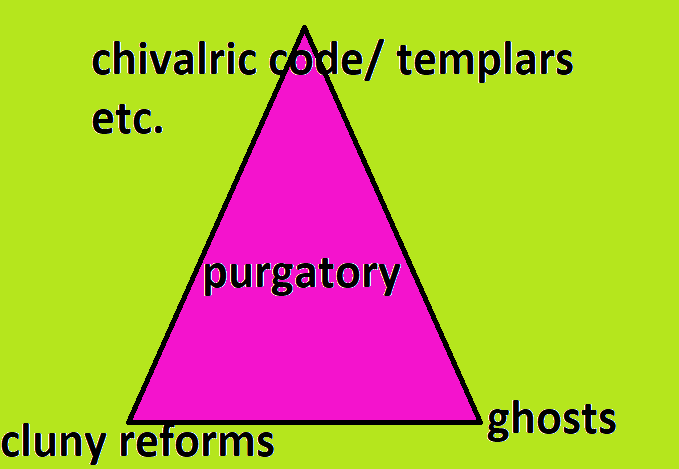
a thing of beauty, no? “but what,” i hear you cry, “about limbo?” i’m getting to that. okay so, while purgatory is official doctrine, limbo was/ is a now largely discarded theory or idea. it doesn’t just apply to babies either: righteous pre-christians get their own limbo (the limbo of the fathers), where they too could enjoy a permanent, peaceful, but non-beatific afterlife. wildest thing about all this to me is that medieval christianity had five afterlives: heaven, the limbo of the fathers, the limbo of infants, purgatory, hell. post-2007 catholics are still “allowed” to believe in the limbo of infants, but they’re also equally free to call horseshit... although probably not in those words.
“but why bother with limbo at all?” you ask. ffs, cloth ears. i’ll recap: a) because without it the rite of baptism may not seem as imperative to catholics as it once appeared. but b) having gone to so much trouble to create purgatory as a horrendous place and well-spring of ghosts in popular imagination, nobody wanted to consign kids there. limbo laid the troublesome ghosts of infants, and made a particularly unpalatable and stern bit of doctrine more easy to swallow. c) from radical limbo of infants exponents such as as peter abelard (1079–1142) to more “mainstream” christian luminaries like everyone’s fave founding cistercian, bernard of clairvaux, key figures within the church were beginning to think seriously about the possibility of salvation of non-christians, especially children. and thinking about them through the lens of god’s mercy. a welcome shift was taking place within the church away from a near-exclusive focus on sin towards grace and salvation. short-lived shift, very partial, but you know, baby steps.
which concludes that ludicrous rabbit warren... for now. and again, i only started thinking about this to begin with in the context of the things we think we know and take as read – about the past, about the present – that are probably, when we scratch the surface, either radically wrong, or else woefully incomplete.
this is also about – – –.
...
*in my capacity as this century’s pre-eminent christian mystic, obvs.**
**not really.